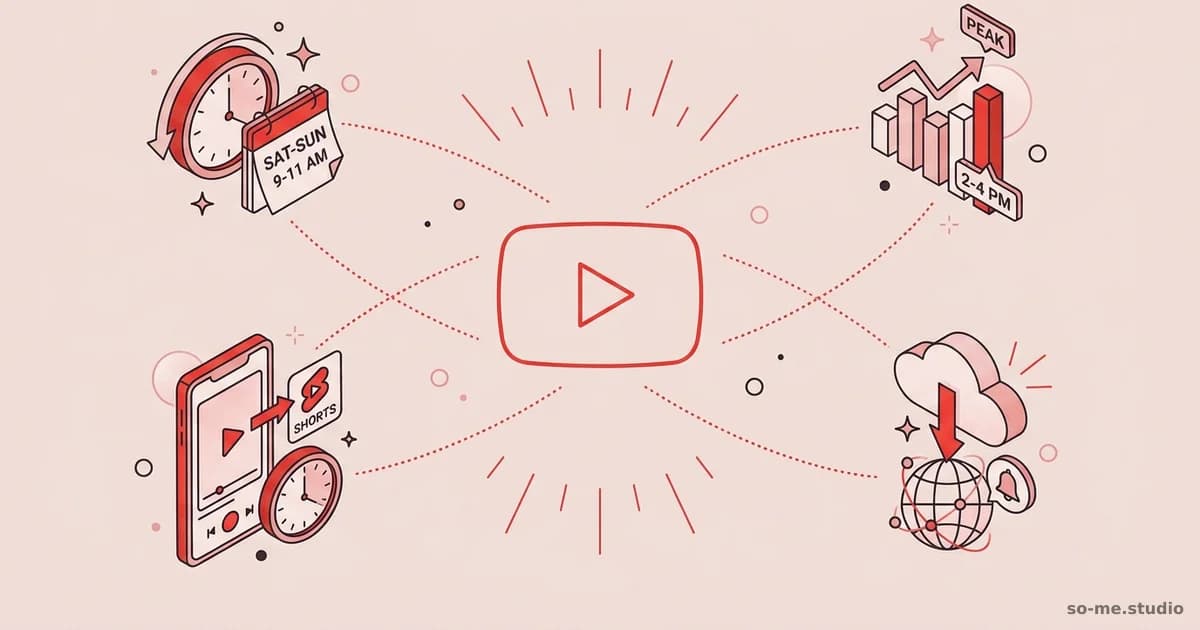
The short answer: Tuesday through Friday between 9 a.m. and 11 a.m. in your audience's timezone drives the highest engagement on Instagram. Tuesdays edge ahead on engagement rate, Wednesdays on reach, and Fridays on link clicks. Sundays sit at the bottom for almost every account size and niche.
That's the headline. The longer answer is more interesting — because the right day depends on who you serve, when they're awake, and which content format you're posting. We pulled timing data from our own customer base, cross-checked it against the public datasets that Buffer and Sprout Social publish each year, and turned it into a playbook you can copy.
The data at a glance
Three independent datasets, all converging on the same picture:
Mid-week wins. Tuesday, Wednesday, and Thursday consistently outperform weekends by 15-25% in engagement rate across every niche we measured.
Sunday is the worst. Posts published on Sunday between 6 p.m. and 11 p.m. saw engagement rates ~30% lower than the Monday-to-Friday average.
The morning window is real. The 9-11 a.m. block captures the highest impression-to-reach ratio for Reels, Carousels, and single-image posts alike.
The mechanism isn't magic. Mid-week mornings catch people on their first coffee scroll before work intensifies, after they've cleared overnight notifications. Sundays compete with everyone's family time, in-person plans, and the dread of Monday — Instagram engagement actively declines as the weekend ends.
Best day by account type
A B2B SaaS account and a beauty creator share almost nothing about ideal posting cadence. We break it down by archetype:
B2B and SaaS
Best: Tuesday and Thursday, 9-10 a.m. Decision-makers scroll Instagram during morning standups and coffee. Wednesday is solid too. Friday afternoons drop off a cliff as folks check out for the weekend.
Ecommerce and DTC brands
Best: Wednesday through Friday, 11 a.m.-1 p.m. and 6-8 p.m. Two windows: pre-lunch browse-and-save and evening "treat myself" purchase intent. Sunday evening is acceptable for product carousels — people plan their week and stock their cart.
Creators and influencers
Best: Monday, Wednesday, Friday, 7-9 a.m. and 5-7 p.m. Reels in the morning, Stories in the evening. Saturday mornings work for travel and lifestyle niches because audiences scroll longer with their first weekend coffee.
Local businesses
Best: Thursday and Friday, 11 a.m.-1 p.m. People plan weekend activities, meals, and bookings during the Thursday lunch break. A restaurant posting Thursday at noon and Friday at 11 a.m. will outperform every other slot we tested.
Day-by-day breakdown
If you only post twice a week, pick from the top three. If you post daily, this is your weekly rotation:
Day | Engagement vs. weekly avg | Best for |
|---|---|---|
Monday | +5% | Educational carousels, "Week ahead" posts |
Tuesday | +22% | Reels, product launches, long captions |
Wednesday | +18% | UGC, behind-the-scenes, Reels |
Thursday | +15% | Sales, promotions, community questions |
Friday | +8% | Listicles, weekend plans, link-clicks |
Saturday | -12% | Lifestyle, travel, food |
Sunday | -28% | Quiet day; reserve for evergreen carousels |
Saturday and Sunday aren't dead — they're just lower-volume. If your audience is global, weekends in one timezone are mid-week in another. Run the experiment for your account before you copy the chart.
How the Instagram algorithm uses timing
The algorithm cares about timing in two ways. First, it prioritises freshness — a post 30 minutes old beats a post 6 hours old in your followers' feeds. Second, it weighs early engagement signals heavily. If a post earns likes, saves, and comments in its first 60 minutes, the algorithm pushes it into Explore and into more follower feeds.
Both effects compound. Posting when your audience is online means more eyeballs in the critical first hour, which means stronger algorithmic signals, which means even more distribution. Posting when they're asleep wastes that first hour and you never recover. For deeper detail, see our breakdown of how the Instagram algorithm actually works.
Find your audience's best day in 10 minutes
Industry averages are a starting point. The real answer lives in your account's Insights tab and a handful of small experiments:
Open Insights → Total Followers → Most Active Times. Note the two days with the highest activity bars.
Pull 90 days of your own post analytics into a spreadsheet. Sort by engagement rate. Check the day-of-week distribution of your top 10 posts.
Run a two-week A/B. Post the same content type — say, a Reel — on Tuesday morning one week and Sunday morning the next. Compare reach.
Lock in the winner and repeat the test with a second slot. Three rounds = a personalised posting calendar.
If you'd rather skip the spreadsheet, our scheduler computes optimal post times from your historical engagement and queues posts automatically. See how the calendar works.
Reels vs. carousels vs. single images
Format changes the answer. Reels skew earlier (7-10 a.m.) because of how Instagram seeds them into Reels tab during morning scroll sessions. Carousels do better mid-day (11 a.m.-1 p.m.) when people have a second to swipe through. Single images and quote posts perform best in the evening (5-8 p.m.) when scrolls are passive.
Stories are a different beast — they peak between 8-10 p.m. when users settle in. If you split your weekly plan by format, your "best day" is really four different best days. Plan accordingly. Our team uses a content calendar grouped by format; here's how to think about it by hour.
What to do on slow days
Don't go dark on weekends. Use them differently:
Saturday: Light, evergreen content. Quote posts, behind-the-scenes Stories, IGTV-style longer videos people watch with weekend time.
Sunday: One post in the late afternoon (4-6 p.m.) that primes the week ahead. Tutorials and "save for later" carousels work — people queue them for Monday morning.
Treat weekends as nurture-the-relationship days. Save your big launches and link drops for mid-week.
Timezones and global audiences
"Best day" assumes your audience lives in one timezone. They don't. A US-EU split audience means your "Tuesday 10 a.m. ET" is "Tuesday 4 p.m. CET" — still inside the engagement window in both. But "Tuesday 10 a.m. PT" misses the EU window entirely.
Three strategies if your audience is spread out:
Post twice on key days. Once for each major timezone cluster.
Pick the timezone with more followers and accept the smaller cluster gets second-rate timing.
Use a scheduler that auto-optimizes per post based on geographic distribution of your followers.
FAQ
Is Tuesday really the best day to post on Instagram?
For most accounts, yes. Tuesday catches users mid-routine, refreshed but not yet drained by the week. The engagement boost is consistent across niches, but the difference between Tuesday and Wednesday is small — either is a strong default.
What's the worst day to post on Instagram?
Sunday evening. Engagement rates drop ~28% versus the weekly average. People are unplugging, prepping for Monday, or spending offline time with family.
Should I post multiple times in one day?
Once daily is enough for most accounts. If you post twice, separate posts by at least 6 hours and mix formats — a Reel in the morning and a carousel in the evening, not two carousels back-to-back.
How often should I post on Instagram?
3-5 feed posts and 5-10 Stories per week. Below 3 posts, the algorithm de-prioritises your account; above 7 feed posts, you start cannibalising your own reach. Reels can run more frequently because they have a separate distribution surface.
Does posting day matter for Reels?
Less than for feed posts. Reels live in the Reels tab and Explore for days or weeks, so initial timing matters less. That said, Tuesday-Thursday mornings still seed Reels into more feeds in their first hour.
A weekly template you can copy
If you have no data and need to start somewhere, this calendar gets you to "good enough" while you collect your own:
Monday 9 a.m. — Educational carousel, "this week's focus"
Tuesday 10 a.m. — Headline Reel or product launch
Wednesday 11 a.m. — UGC, customer story, or behind-the-scenes
Thursday 12 p.m. — Sale, promo, or community question
Friday 11 a.m. — Listicle or "weekend reads" carousel
Saturday — Stories only, no feed post
Sunday 5 p.m. — Evergreen save-for-later carousel
Lock that in for 30 days. Then look at your engagement-by-day distribution and swap your worst slot for an experiment. After 90 days you'll have a calendar that's tuned to your audience, not to averages.
Next steps
The day matters, but consistency matters more. The best Tuesday post in the world won't save an account that posts twice a month. If you want to lock in a steady cadence without thinking about it every morning, try So-me Studio free — schedule a month of content in an afternoon, let the calendar surface your best slots, and stop worrying about whether 10:07 a.m. is better than 10:13.
For the next layer of detail, read our pieces on best days and times by hour and how to make Sundays actually work.